Transit
The client is a passenger. The carrier drives.Lunacent Medical, Your Interval: A Guide for Clients and Families
A novel
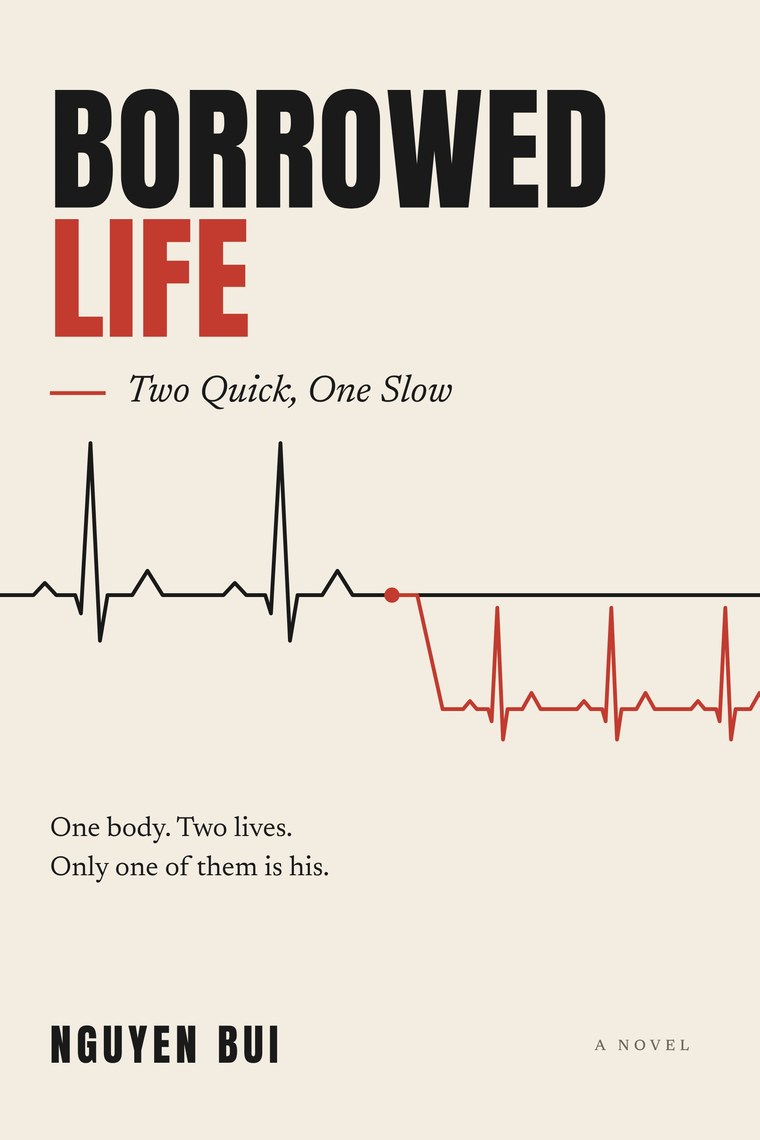
Two Quick, One Slow
One body. Two lives. Only one of them is his.
Paperback and ebook. Release date to be announced.
The story
Daniel Mercer has spent most of his twenty-six years in a hospital bed, mapping places he will never see.
Then he pays for an Interval: three weeks riding inside a healthy stranger's body on the mountain roads of northern Vietnam, feeling the rain for the first time.
Then the mountain moves.
When he wakes, everyone calls him Marcus Quinn: the doctors, his wife Jo, the two children waiting for him at the door. He has a mechanic's hands that know things he never learned. The doctors say the gaps in his memory are normal after four minutes without a heartbeat. But he counts ceiling tiles without knowing why, hums a lullaby nobody taught him, and taps a rhythm on his daughter's hand that belongs to someone else entirely.
As the truth surfaces, so does a company with everything to lose, and a procedure that could give Jo back the man she married.
When one body holds two lives, who gets to decide which one wakes up?
The rhythm
Some things live in the hands, not the head. A mother taps a small rhythm on her sick child's hand to help him sleep, night after night, until it is part of him.
Try it. Tap twice, quickly. Then pause, and tap once more.
quick · quick · slow
Use the circle, or press the space bar while it is selected.
The rain on Ma Pi Leng doesn’t fall. It arrives.
One minute the limestone peaks are standing around the pass like old men in gray coats, shoulders hunched, watching the road. The next minute they’re gone, rubbed out by cloud, and the rain comes down so hard it bounces. It drums on my helmet. It sheets across my visor. It finds the gap at the back of my collar and slides down my spine, cold as a dropped coin, and I laugh out loud inside the helmet, because I can feel it. All of it. Every cold, ridiculous inch.
Three weeks of this, and that still gets me.
Up ahead, Tuan lifts one hand from his handlebars and pats the air. Slow down. Then a flat, chopping motion. Bad road. Tuan has a whole language of hands. He taught it to me on the first morning in Ha Giang, in a hostel courtyard strung with Christmas lights in August, over coffee so thick and sweet it was practically dessert. Since then I’ve read those hands the way you read the safety card on a plane once the plane starts shaking: closely, and with total faith.
I ease off the throttle. The bike is a 125cc Honda with a cracked left mirror and a seat held together with silver tape, and I love it more than anything I’ve ever owned.
The road here is a ledge. There’s no kinder word for it. Somebody took a mountain and cut a shelf into its side, just wide enough for two trucks to pass if both drivers hold their breath, then ran a knee-high concrete barrier along the outer edge, painted red and white like a candy cane, as if that would help. Beyond the barrier there’s nothing. Air, and cloud, and somewhere far below, the Nho Que River twisting through its canyon. On our first clear morning it was the impossible green of a glass bottle held up to the sun. Today, when the fog tears open for a second, I catch a glimpse of it, brown and swollen.
Tuan said that was a bad sign. Tuan says a lot of things are bad signs. He also says I ride like a grandmother, which I’ve decided to take as a compliment.
We pass a cornfield planted on a slope so steep the stalks look like they’re climbing it. We pass a house of rammed red earth with a satellite dish on the roof and a dog asleep in the doorway, so sure of its spot that the rain doesn’t wake it. We pass a woman in an indigo jacket walking a water buffalo on a rope, both of them soaked to the skin, both of them completely unbothered. She glances at me. I lift two fingers off the grip, the way I’ve seen Tuan do it a hundred times, and she lifts her chin in return. A whole conversation, finished in a second.
I’m here, I keep thinking. I’m actually here.
There’s a pressure behind my eyes, faint and steady, like a thumb pressed gently against the inside of my skull. Someone described it to me once, before any of this, and I didn’t believe them. You’ll get used to it, they said. You’ll stop noticing.
I haven’t stopped noticing. Most of the time it just sits there, the way your tongue sits in your mouth. But every so often, when the road goes quiet and my mind goes quiet with it, I can feel him. Not his thoughts, exactly. More like his weather. A front moving through. A tiredness that isn’t mine. A low, nagging worry about money that drifts in and out like a radio station on a long drive.
He’s quiet today. Mostly, he is.
I don’t choose the road. That was decided months ago, in an office, by people with a brochure and a payment plan. My part is simpler. My part is to be here for every mile of it, and I am. God, I am.
The rain thickens. Tuan’s taillight shrinks to a red smudge in the gray, and I follow it around the next bend, and the next, the mountain on my left and nothing on my right, my whole body humming with the engine like a plucked string.
The rain eases a little after two, the way Tuan promised it would, and we pull in at a roadside stall wedged into a bend.
It isn’t much. A tin roof on four bamboo poles. A tarp lashed across the back to keep out the wind. Three plastic stools in kindergarten colors, and a grandmother crouched over a cut-down oil drum full of glowing charcoal, turning ears of corn with her bare fingers. When Tuan cuts his engine, the silence rushes in so fast it makes my ears ring. Rain ticks on the roof. Somewhere down the slope a rooster is complaining about the weather.
I take the red stool. It’s so low my knees come up nearly to my chin, and I drop onto it without thinking, without bracing, without planning the move in three careful stages the way you plan a move you might not survive. It’s such an easy thing that it catches me like a missed step on a staircase. So I stand up again, just to do it. Then I sit back down.
Tuan watches me over his corn. “Your legs are okay?”
“My legs are perfect.”
“You are strange man,” he says, not unkindly, and goes back to eating.
The corn is charred and chewy and brushed with scallion oil, and it’s the best thing I’ve ever put in my mouth. I tell Tuan this. He tells me I said the same thing about the noodle soup in Dong Van, and the sticky rice in Yen Minh, and the corn wine at the homestay last night, which nearly took the skin off the back of my throat. He’s right. I’m not embarrassed about it. Some days everything is the best thing.
The chapter continues in the book.
The world
In the coastal city of Calder, medicine is the main industry. Patients too sick to leave their beds can buy a few weeks inside a healthy stranger: a carrier, paid to let a passenger ride along through his senses.
The company that sells these trips calls them Intervals. Everyone else calls them mind vacations. The brochure is glossy. The payment plan is reasonable. Nobody reads the fine print until it matters.
Lunacent Medical is a fictional company in the novel. Restorative procedures are covered in the Carrier Services Agreement, page forty.
Inside the book
The client is a passenger. The carrier drives.Lunacent Medical, Your Interval: A Guide for Clients and Families
Clients sometimes report a sense of belonging in the carrier’s home and among the carrier’s family. This is normal, and it fades after Homecoming.Lunacent Medical, Your Interval
For all legal purposes, identity follows the body.Lunacent Medical, Carrier Services Agreement, Section 4
suppressed (adj.): temporarily inactive; capable of being restored.Restorative Protocol R-7, Glossary of Terms
The people
Twenty-six, and sick for most of it. He has read about every road on Earth. The Interval is his first time on one.
Mechanic, husband, father of two. For eleven years he has rented out his body to strangers so the bills get paid.
She has waited up after every trip, at the same kitchen table, for the man who comes home. This time, he seems more present than ever.
A school librarian who has spent years beside a hospital bed, counting the beeps. She bought her son one adventure.
Clinical Risk at Lunacent Medical. Her job is to make problems disappear. Then she finds eleven seconds of data that shouldn't exist.
Eleven and five. They notice everything about their father, including the things that have changed.
The brain is wider than the sky,Emily Dickinson
For, put them side by side,
The one the other will include
With ease, and you beside.

About the author
A psychotherapist and tech geek by day, and an amateur novelist and game programmer by night.
The day job is listening to people figure out who they are. The night job is building worlds that ask the same question with the rules changed. Borrowed Life came from somewhere in between.
Get the book
The paperback and ebook will be available on Amazon. Check back here for the link on release day.